The short answer is that the back of a book cover usually has a blurb of about 150 words, an author bio of about 50 words, a headshot, up to three endorsements, and the barcode. You can also add your website, social media handles, and imprint logo. It varies per book though.
What a lot of authors don’t realize is that the words on the back of a book cover are really important. After the front cover, it’s one of the first things a buyer looks at, and it’s what makes them at least open the book and read the first few lines instead of putting it back on the shelf.
That’s why it’s worth getting help with your jacket copy—also called a book blurb or back cover copy—even if you’ve already written it, or you’ve written it with AI. It needs to sell the book, not just summarize the content (or the story, if it’s fiction). Inksnatcher, a self-publishing services company, can help with this.
Even if your cover is amazing, you can’t rely on that alone. It doesn’t matter what kind of book you’ve written. Maybe it’s a memoir, a devotional, a business book, or some really good historical fiction. It’s the cover, the jacket copy, and the author bio together that earn the reader’s trust.
What is jacket copy?
Jacket copy, also called a blurb, is the publishing term for the marketing words on the back of a paperback or hardback. Its job is to:
Jacket copy for nonfiction
Jacket copy for nonfiction tells the reader what they can expect to gain.
Start with a really strong hook. This is why you need to know what your reader’s problem is, so you can show that your book answers it. Or the hook can simply spark curiosity.
Follow that with two or three short paragraphs about what the book delivers. Be careful with the tone, and make sure the reader knows what to expect from reading it, whether that’s a changed life, real results, or something else. Make sure the voice you use for the jacket copy is yours. For nonfiction especially, keep it professional and clear. Avoid AI slop, avoid claiming things that just aren’t true, and avoid buzzwords most people wouldn’t understand unless they were in that particular industry.
Below is a good example of a nonfiction book’s blurb.
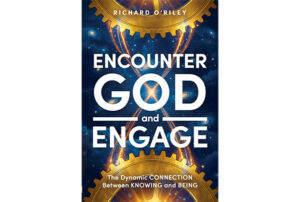
What sustains an encounter with God?
Christians crave encounters with God, but the Christian life was never meant to be built solely on encounters. Encounter is a personal invitation to walk in victory with our Savior.
In Encounter God and Engage, Richard O’Riley explores what it means to move beyond knowing God to being known by Him, and to embrace the active, obedient life He calls us to live. Drawing from biblical stories, contemporary events, personal testimony, and decades of ministry, O’Riley reveals how transformation really takes place.
If you’ve longed for “big moments” with God, then wondered how to bring Him glory, this book will show you how to:
- Hear God’s voice clearly.
- Live as both a lover and a warrior.
- Partner with God in faith to make a lasting impact on the world.
- Become more like the bride of Christ.
The encounter/engage dynamic is designed to guide, strengthen, and promote our maturity in Christ. It’s time to move from spectator to ambassador and let your life become a living testimony of God’s power at work through you. Will you start today? (From Encounter God and Engage by Richard O’Riley)
Jacket copy for memoir and fiction
When writing the back cover copy for memoir and fiction, the focus is on the main character’s journey or the plot of the book. Strong jacket copy gives readers enough detail to draw them in without giving away the whole plot.
For fiction, make sure the stakes are in there as well as the story, so readers can see there’s a buildup.
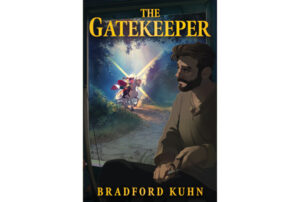
John lives a solitary life, intentionally removed from the turmoil of politics and the danger of magic, until the day a mysterious, wounded woman collapses on his doorstep, bringing chaos—and an unexpected inheritance—into his isolated world. Suddenly thrust into the role of a gatekeeper, an important but dangerous position tied to a powerful gem, John is thrown into the center of a complex web of intrigue, magical politics, and deadly threats. As supernatural attacks escalate and shadowy forces close in, John must quickly learn who to trust in a realm where deception rules.
Reluctantly guided by an eccentric cast of allies—including a sarcastic doctor, a headstrong knight, and one loyal horse—John must find a way to survive the maelstrom of politics before dark forces unravel everything he knows and loves.
Blending fantasy, suspense, and sharp wit, The Gatekeeper is a heady tale of one man’s reluctant journey from seclusion to heroism, and the secrets that threaten to destroy him along the way. Will John welcome his destiny, or will the burden of being the gatekeeper destroy him first? (From The Gatekeeper by Bradford Kuhn)
Memoir
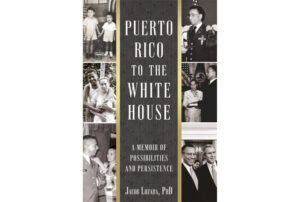
From Puerto Rico’s public housing to the corridors of power in Washington, D.C., Dr. Jacob Lozada’s life is a testament to perseverance, discipline, and purpose.
Born and raised in a caserío in San Lorenzo, Puerto Rico, Jacob Lozada overcame cultural, linguistic, and economic barriers to serve with distinction in the U.S. Army Medical Corps, eventually rising to the rank of colonel. After twenty-seven years of military service, he transitioned to the private sector, and then to national leadership as Assistant Secretary for Human Resources and Administration at the U.S. Department of Veterans Affairs, appointed by President George W. Bush.
In this candid memoir, Dr. Lozada shares the defining moments of his life: the struggles of his upbringing, the influence of his steadfast parents, and the values that propelled him forward. Puerto Rico to the White House is more than a personal story—it’s an inspiring call to believe in what’s possible, no matter where you begin.
How long should a book blurb be?
A book blurb is usually two to three paragraphs, including that opening hook. That’s about 150 words. You might think that doesn’t fill much of the back cover, but we also need room for your bio, the barcode, and margin—the space around the edges. We can fit your website URL, imprint logo, and social media handles there too.
The normal thing is to write both the copy and bio in third person.
Paperback vs. hardcover

A dust jacket for A Stunning Betrayal by Terence Davis
On a hardcover that has a dust jacket with flaps, the blurb often goes on one of the inside flaps to leave room for endorsements on the back. The other flap might have a note from you about why you wrote the book, your bio and photo, or just your online handles.
Some hardcovers are printed directly onto the board with no flaps, so they are treated the same way as paperback covers.
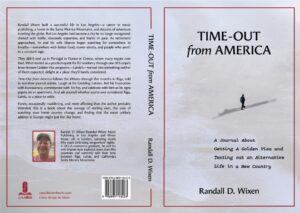
A paperback cover for Time-Out from America by Randall Wixen
On a paperback, everything goes on the back cover.
Should my author bio go on the back cover?
For nonfiction, your bio usually goes on the back cover. Most novelists leave it off the back and just have one longer bio inside the book.
A good bio shows the reader that you know what you’re talking about, that you have experience in the subject, and that they can relate to you. Aim for about 50 words, or two to four sentences. Here’s an example:
Dr. Jacob Lozada is a decorated Army veteran, mentor, and public servant, profiled by Hispanic Business Magazine as one of the 100 Most Influential Hispanics and by National Journal as one of Washington’s Decision Makers. A man of deep faith, Dr. Lozada champions education, service, and leadership. Now retired in Austin, Texas, he enjoys hiking, traveling, and time with his family and grandchildren. —From Puerto Rico to the White House
If you’ve written a Christian book, add your ministry involvement, any related degrees, or a little about your experience in that ministry. Just don’t make it too long, and don’t fill it with buzzwords. You want it to be accessible to everyone. You’ll still get to put a longer bio inside the back of your book and on your Amazon listing, but the back cover is where it needs to be short and sweet and to the point. For example:
Pastor Rick Craig, author of the When It’s Time® series, is a pastor, speaker, life coach, and funeral officiant. With backgrounds in ministry, counseling, business, and leadership, he now leads seminars, appears on podcasts, and continues serving veterans and families while enjoying life with his wife, Lauren.
Even if you have no credentials for the type of book you’ve written, we can help you word your bio in a way that shows you know the material and that you can help the reader. For faith-based authors, it’s absolutely fine to include Scripture and ministry roles, but keep them relevant to what your book is about. You’re not writing a résumé. You want to present yourself as a guide to the reader.
Also, a good author photo is required. It needs to be professional and match the genre of your book.
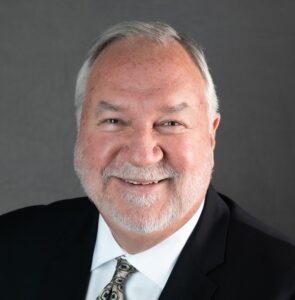
Rick Craig, author of 6 Hallmarks of a Fantastic Fourth Quarter
Do I need endorsements on my book cover?
People are backing off putting a lot of endorsements at the front of a book these days, because they say nobody reads them. But three really strong one-liners on the back cover from people who’ve read the book can help sell it for sure.
For nonfiction, recognizable names are always good, but they don’t have to be recognizable if you can’t get those. Keep it to no more than three, and make sure they’re short, specific, and relevant to what’s in your book. We can help you choose your top three. Here is how some looked on the inside flap of Marie Lynch’s beautiful book Praying in Pregnancy:
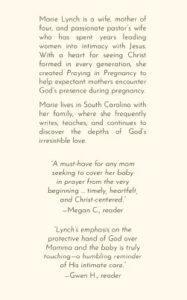 The inside flap of the dust jacket for Praying in Pregnancy by Marie Lynch
A lot of people will say they’ll give you a review, and then they don’t come through. Get an early copy to them months in advance so they have plenty of time. And if friends are hard to rely on, Inksnatcher partners with book reviewers.
Your Amazon description or book listing page
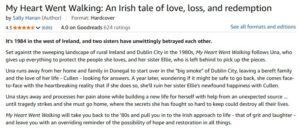 Amazon listing for My Heart Went Walking
While you’re writing your jacket copy, think about your Amazon description too. It will be slightly different. It can be longer, it can include keywords, it can be formatted, and it’s written specifically for someone on Amazon searching for your type of book.
When should I write my back cover copy?
The best time to write the jacket copy is once the book is edited, the layout is done, your front and back matter are in, and you’ve chosen your cover design. That’s when we add the jacket copy to the back with your file. If you’ve bought a complete publishing package with Inksnatcher, this is built into your timeline, and we’ll let you know when it’s time.
Other Questions About Your Book Cover
Can I do my own cover design?
You can, but you really need a professional to do your cover. We know a lot of authors have fun in Canva or on other platforms choosing colors and fonts and pictures, but it’s not going to look professional unless a professional cover designer does it. Even if you already have a picture that could work, you still need a designer to finish it, add the spine and the back, and make it publishable.
Everything (the pictures, the fonts, the colors, the layout) should match your book’s genre and message.
A hardcover devotional needs to look clean and trustworthy. A novel about nurturing abandoned children needs a quieter, hopeful feel. A children’s book needs to be bold and bright.
Should my book have a tagline?
A tagline can help a lot. It needs to be very short and be part of your book’s pitch, and you can use it in your ads and any other marketing across different platforms. For example, a novel about a woman working for an anti-Semitic influencer could use the tagline A story of anti-Semitism, faith, and betrayal.
Do I still need jacket copy for my e-book and audiobook?
No, because there is no back cover, and the book listing does the work for you there.
Can I update my blurb or jacket copy after I publish my book?
Yes, on your cover file, which will then have to be uploaded again to your publishing platforms. Your online book listing can be changed at any time.
Need help?
If you’re not sure what to put in your jacket copy, we can help for sure. Our Deluxe package includes writing your jacket copy and your bio. We’ll craft them to fit your cover and appeal to your readers.
Just email us and we’ll get started.